Köln – Perpignan reaktiviert

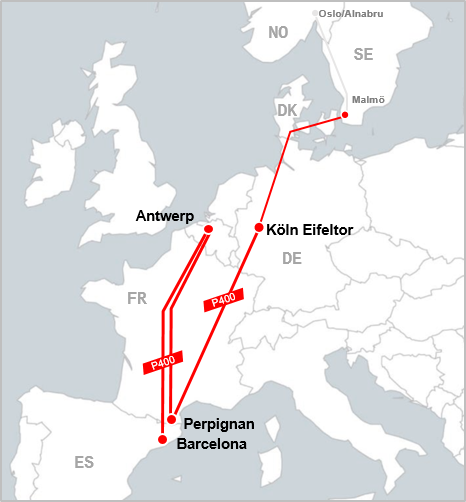
Nach dem Corona-Virus-bedingten Stop reaktiviert Hupac die Linie Köln – Perpignan. Erste Abfahrt war am 27.04.2020, angeboten werden zunächst zwei Rundläufe. Es soll ein Ausbau auf fünf Rundläufe/Woche erfolgen. Die mit Profil P400 nutzbare Verbindung verkehrte erstmals am 16.03.2020 ab Köln und bietet Durchbindungsmöglichkeiten von Nordspanien / Pyrenäen bis Skandinavien.

Grafik: Hupac

Regular container train service established between Cologne and China

For weeks, the world’s second-largest economy was virtually at a standstill due to the coronavirus crisis. China has since restarted large parts of its industrial sector and resumed international trade. This is one of the reasons why a regular container train service is now set to be established between several major Chinese cities and Cologne.
This weekend, the first regular scheduled train, designated DBO-W155, arrived at CTS Container-Terminal GmbH in the Port of Cologne-Niehl; the 22 railcars arrived on time at the trimodal transshipment terminal operated by the HGK affiliate. The containers, carrying all kinds of goods, are primarily destined for companies in Cologne and the surrounding area. However, containers can also be forwarded via regular train connections from Cologne to destinations in the greater Milan area, as well as to Valencia, Rotterdam, Antwerp, Bremerhaven, Hamburg, Aschaffenburg, and Schweinfurt. On Saturday evening, the train departed Cologne and headed back toward China.
“Especially in times of crisis like the COVID-19 pandemic, the supply of goods to the population must be guaranteed. This also includes goods produced in China. Conversely, goods manufactured in the Rhineland are in demand in China. So it’s only logical to launch this connection,” say CTS Managing Director Oliver Grossman and Oliver Haas, CTS General Manager of Business Development.
Once a week, the train connects Cologne with major Chinese cities such as Chongqing, Xiamen, and Xi’an. Within China, the freight can then be redistributed to a total of 120 additional destinations. The transit time for the containers ranges from about 13 to 19 days, depending on the destination. The price is comparable to that of ocean freight, but the goods reach their destination in about one-third of the time.


Häfen und Güterverkehr Köln AG Press Office Scheidtweilerstraße 4 50933 Cologne
 0221 390-1190  0221 390-1191 presse@hgk.de www.hgk.de
The Zug product is provided by DBO Bahnoperator GmbH and the China-based company BTE (Beijing Trans Eurasia). The two companies operate at a total of eight locations in China and Europe and employ a total of 200 people. With more than 500 trains per year, the consortium is one of the market leaders in rail container transport to and from China.
Rail connection also attractive for shipments to Eastern Europe
Thanks in part to the Chinese freight railway CRCT (China Railway Container Transport), transit times within China can be significantly reduced, which benefits the local export industry. The connection is supported by the Russian, Kazakh, and Belarusian railways. Along this route, containers can therefore be booked from Cologne to Poland, for example. Within Europe, DBO utilizes large and medium-sized private railways to guarantee the best possible transport service. RheinCargo handles the so-called “last mile” to the Port of Niehl.
The neska Group, a subsidiary of HGK AG that holds a 62.5 percent stake in CTS Container-Terminal GmbH, views the new connection as a model for others to follow. “In the intermodal business, neska operates six modern, trimodal container terminals that are ideally located in metropolitan areas and are intelligently connected to one another and to seaports via their own inland waterway vessels and rail systems. In addition to maritime transport, we also see enormous potential in continental transport,” said neska Managing Director Stefan Hütten.

RCG verbindet China und Budapest

Arrival of a very important train with an even more important load! 😷 Today, RCG board member, Imre Kovács welcomed our first Jinan-Budapest train, fully loaded with masks and disinfectants – which came much faster than by ship and much cheaper than by air! This train was the first train of our 3 new Eurasia #TransFER connections, which we have launched as an immediate reaction to the Corona crisis due to a higher demand for direct #Eurasia connections with short transit times.

https://www.linkedin.com/posts/cfoerst_transfer-corona-eurasia-activity-6660537977191583746-R-77

RFO for APMT to North Brabant

  > KV transport services Maasvlakte West – North Brabant (alternating between
Acht and
> Tilburg (Railport Brabant)); 3 times a week
>
> for APMT
>
> Portshuttle suspended?

"PortShuttle Rotterdam" container transport service between Maasvlakte West and North Brabant (alternating between Acht and Tilburg (Railport Brabant)); 3 times a week since March 20, 2019, on behalf of PortShuttle Rotterdam B.V.

We are currently no longer operating the PortShuttle train to and from Tilburg/Eindhoven. This is partly because ridership has dropped significantly.

Monday, March 30, Tilburg: First time Tuesday, March 31, Eindhoven: Eight: First time

Tilburg 3 and Eight, twice a week.

BLS Cargo / Crossrail instead of LINEAS

The Antwerp–Frenkendorf service offered by Schweizerzug AG, which operates six round trips, has a new operator: Instead of LINEAS via the Montzen route, BLS Cargo / Crossrail Benelux has been operating the service via Venlo and Roosendaal since January 1, 2020.

No More Containers in East-West Trains to Rotterdam

In the last quarter of 2019, container transport via E-trains came to an end. The train carried coal (ore?) from EMO Rotterdam to the voestalpine steelworks in Linz and was partially loaded with containers on the return trip. These shipments are now handled via Hamburg. The containers are unloaded at Eurokombi and then transported to Hansaport for loading. The containers are unloaded from the Eurokombi and then transported to Hansaport for loading. Since June 2019, the ore for voestalpine in Linz has been handled almost entirely at the Port of Hamburg. This date also marked the near-complete end of ore shipments to and from Neuss and Rotterdam (only one train pair is believed to remain). To the best of my knowledge, container services in E-cars are currently limited to KT 47930 XALSH – AWHOS on Mon/Tue and KT 47932 XALSH – AM S on Thu/Fri.

https://www.flickr.com/photos/134997500@N03/49743452951/
Source: https://www.flickr.com/photos/134997500@N03/49743452951/

Poznań & Duisburg verbunden

Clip Group together with Duisport and PKP Cargo launches a regular train from Poland to Germany transporting semi-trailers 3 times a week. In response to the growing administrative restrictions on international road transport and the increasing costs this kind of transport, in the coming days Clip Intermodal, Duisport Agency together with PKP Cargo S.A. start intermodal rail shuttle on the Poznań – Duisburg route. Technically, the connection will be ready to start on 01/04/2020, but will be launched as orders arrive. Currently planned connection frequency is 3 times a week, but in the case of high interest we are able to increase the number of connections to the daily service very quickly. The planned composition of the wagons will allow not only intermodal units to be transported, but also so-called semi-trailers. standard using the CargoBeamer system. The transit time by train between Poznań and Duisburg is only 14 hours. The capacity of each train is 36 semi-trailers or 45-foot containers, which will allow unloading roads by more than 10,000 trailers per year and avoid CO2 emissions in the amount of about 15,000 tons. An additional benefit in intermodal transport is the possibility of loading up to 26t of goods onto a single semi-trailer. I

https://www.linkedin.com/posts/clip-logistics-sp-z-o-o-_clip-group-together-with-duisport-and-pkp-activity-6649265046818037760-frGF/

Terminalbetreiber Kodersdorf benannt

Das neu errichtete Intermodalterminal in Kodersdorf nahe der polnischen Grenze hat einen Betreiber. Nach einer Ausschreibung wurde am 16.03.2020 der LION Logistics GmbH der Zuschlag erteilt.

Eigentümer der Anlage ist die am 18.01.2019 mit Sitz in Forst (Lausitz) gegründete RS Terminal GmbH. Deren paritätische Gesellschafter sind mit Sven Noatzke (45) der Gründer und Inhaber der LION Group sowie Robert Zarzecki (35) als Mitinhaber und Vorstand des polnischen Unternehmens Citronex. Beide Gesellschaften gehören zu den Hauptnutzern der Anlage. Citronex ist Großkunde auf den Zügen von LION Logistics und importiert so Zitronen aus den deutschen Nordseehäfen.

Das neue Terminal hat die Anlage der LION Logistics in Forst komplett substituiert. Aktuell wird Kodersdorf acht Mal pro Woche mit den deutschen Nordseehäfen (Hamburg, aktuell v.a. Bremerhaven) verbunden. Die erste Meile übernimmt LION Rail, die Langstrecke die Captrain-Tochter ITL Eisenbahngesellschaft.